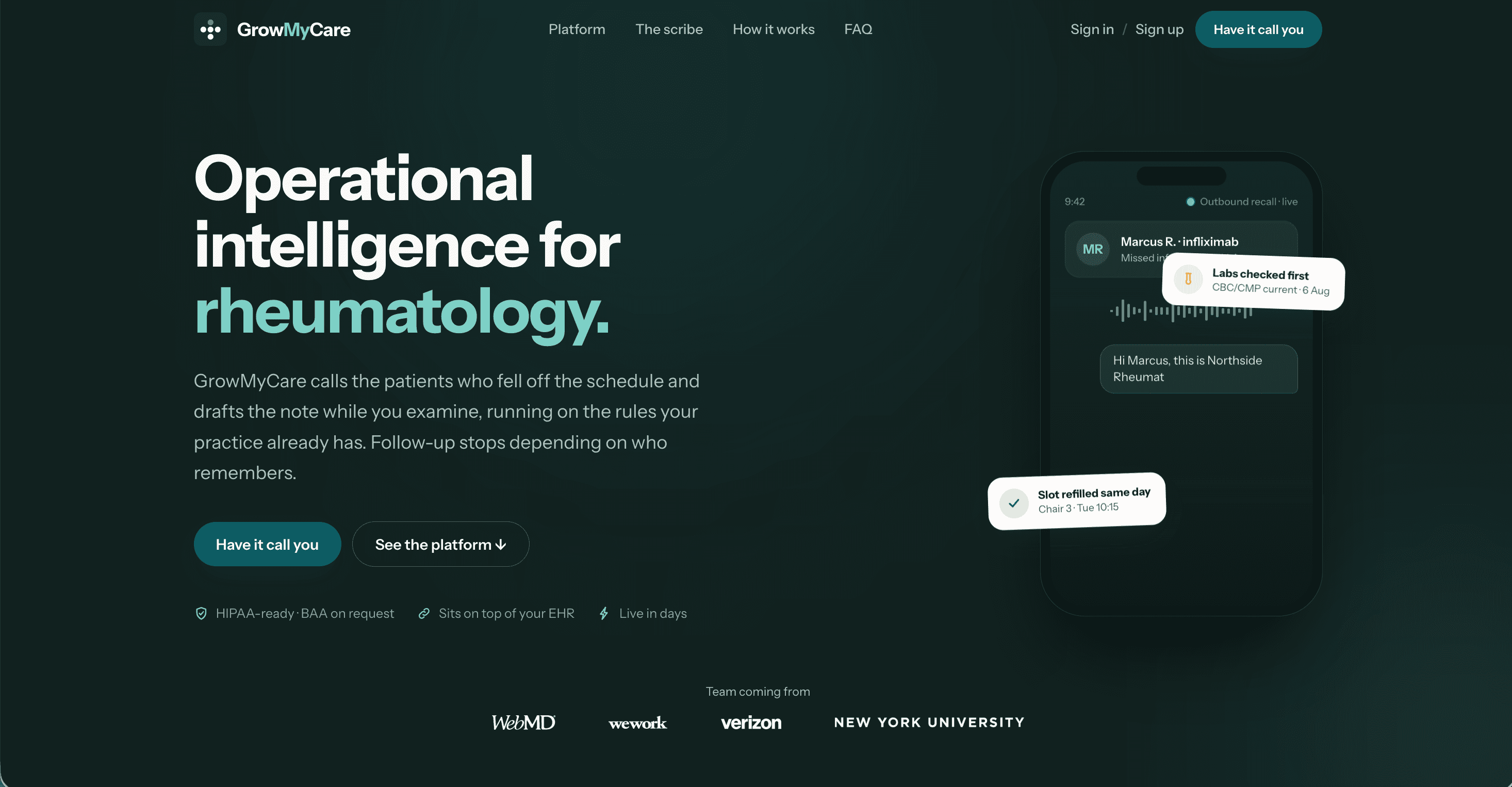
Context and problem
Healthcare runs on admin work today, and most of that work has nothing to do with the medicine a doctor actually trained for. Every visit turns into paperwork, every bit of paperwork turns into a process, and every process ends up being something a doctor is putting out like a small fire between patients.
GrowMyCare came to us wanting that weight lifted. Not a new chart system, not another dashboard to keep open. Flows built specifically to take the mental load off a doctor's shoulders, so the day goes back to being about the patient sitting in front of them.
Grunt work looks the same in almost every industry: following a process and keeping documentation straight under a deadline nobody actually chose. We had already spent months untangling exactly this kind of problem in dentistry, so the patterns were familiar before we ever opened GrowMyCare's own workflow. That head start let us go straight for the real nuances of a rheumatology practice instead of relearning the basics. See our dentistry case study, OccluMap.
Approach
A doctor needs to recall a patient's whole history in about a second. Interruptions are constant in this job. A nurse calls them away, an urgent case walks in, a shift ends mid sentence. Every one of those moments forces a context switch, and doing that dozens of times a day wears on a mind in a way that has nothing to do with medicine.
So we designed everything around three things:
- Pull up a patient's history the moment the screen opens, not after a search.
- Put the same action in the same place every time, so the eye builds muscle memory instead of hunting for it.
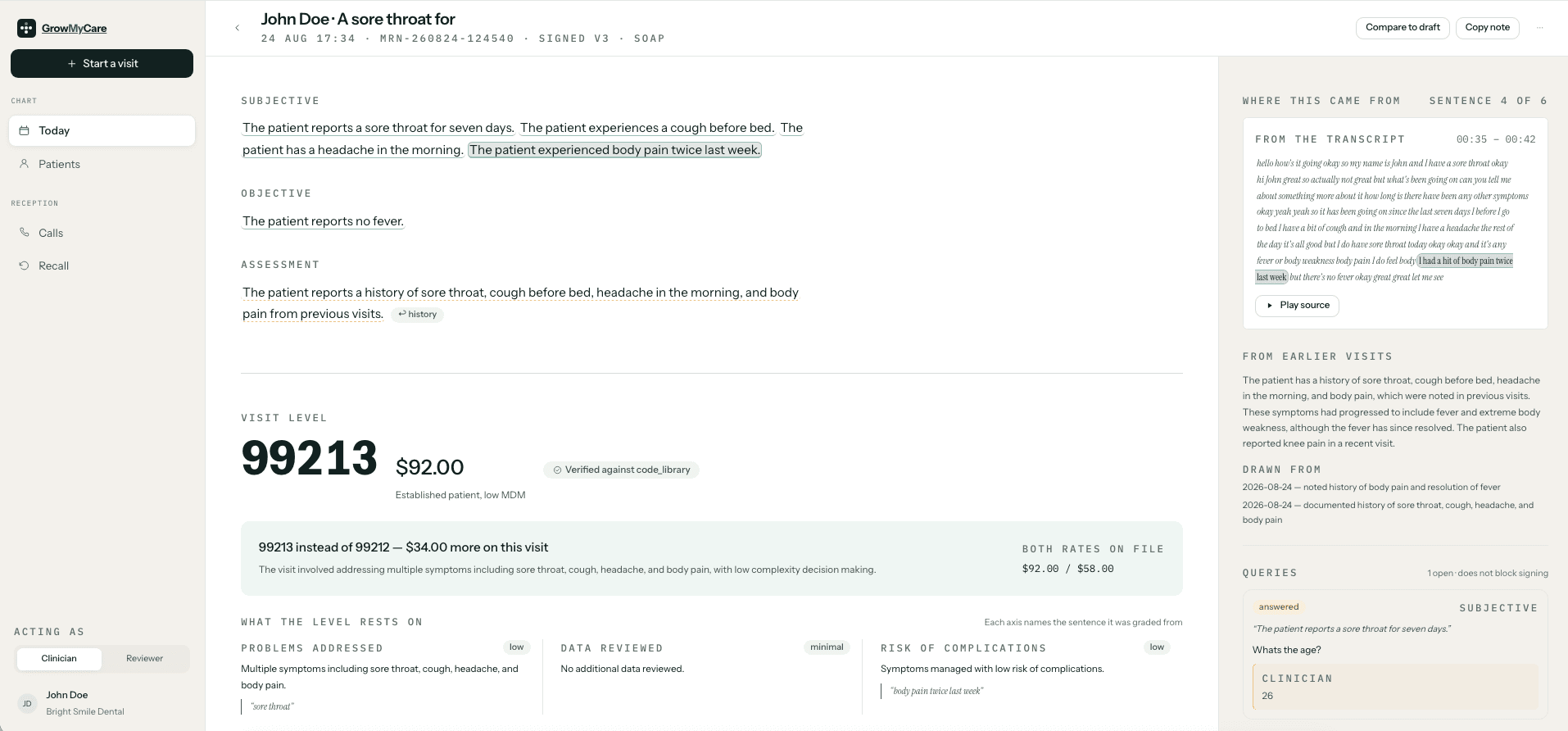
- Let ambient AI listen in the background and quietly finish the parts of the workflow a doctor doesn't have time to close out.
Scribing, scheduling, recall calls, patient activation: every one of those features was built around the same assumption. A doctor could leave in the middle of any of them, at any second, and the work still had to be left in a state where nothing was actually lost.
| What we built | What it's answering | What it looks like in practice |
|---|---|---|
| Instant recall | A doctor walking back in with zero context | Patient history is already on screen before they sit down |
| One consistent layout | Decisions competing with muscle memory for attention | The same field sits in the same place, visit after visit |
| Ambient AI in the background | A task left unfinished when a doctor has to leave | Listens through the visit and quietly closes out what it safely can |
Scroll sideways to see every column.
What we built
Designing a conversation that feels real
This was the hardest part of the whole project. General prompting does not hold up on a real call. We sat down with actual phone recordings and picked them apart: who was on the line, what the patient's background actually was, what the staff on the other end needed to hear. Out of that we built a storyline behind every call, so the agent had somewhere real to draw a response from instead of guessing at one.
That habit of studying conversations sentence by sentence turned into a skill on its own, one we've carried into other voice work since.
Once the conversation itself felt right, we spent real time on the plumbing underneath it. We engineered voice handling until response time sat under 150 milliseconds. Real time audio processing is the kind of problem we enjoy, and getting it that tight is what makes a call feel like a person on the other end instead of a system waiting its turn to speak.
Scribing and auditing every note
Healthcare leaves no room for a note nobody can trust. We reused a logging system we had already engineered for exactly this kind of traceability and pointed it at every clinical note GrowMyCare's agent writes. Every sentence in a note can be traced straight back to the moment in the actual conversation it came from.
That gave the note taking process reliability a doctor can actually check, not just take our word for. A doctor can draft the why behind every procedure now and know the record behind it holds up, because it's grounded in what was really said and not in what an agent decided sounded reasonable.
Keeping a doctor in the loop on every report
No amount of automation changes who the trained professional in the room is. The doctor is still the right person to give final approval, so we built the system around human in the loop review from day one. Every report waits on a doctor's sign off before it becomes official, which is exactly what keeps the whole system accountable.
| Challenge | What we did instead of the obvious shortcut | What it delivers today |
|---|---|---|
| A voice agent that sounded scripted | Storylines built from real call transcripts, not a generic prompt | Calls that respond like they actually understood what was said |
| Calls that felt a beat too slow | Voice handling engineered end to end | Response time under 150 milliseconds, live |
| Notes nobody could fully trust | Reused our own logging system for full traceability | Every sentence traces back to the exact moment it was said |
| Automation with no one checking it | Human in the loop review built in from the start | Every report waits on the doctor's sign off before it's official |
Scroll sideways to see every column.
Outcome
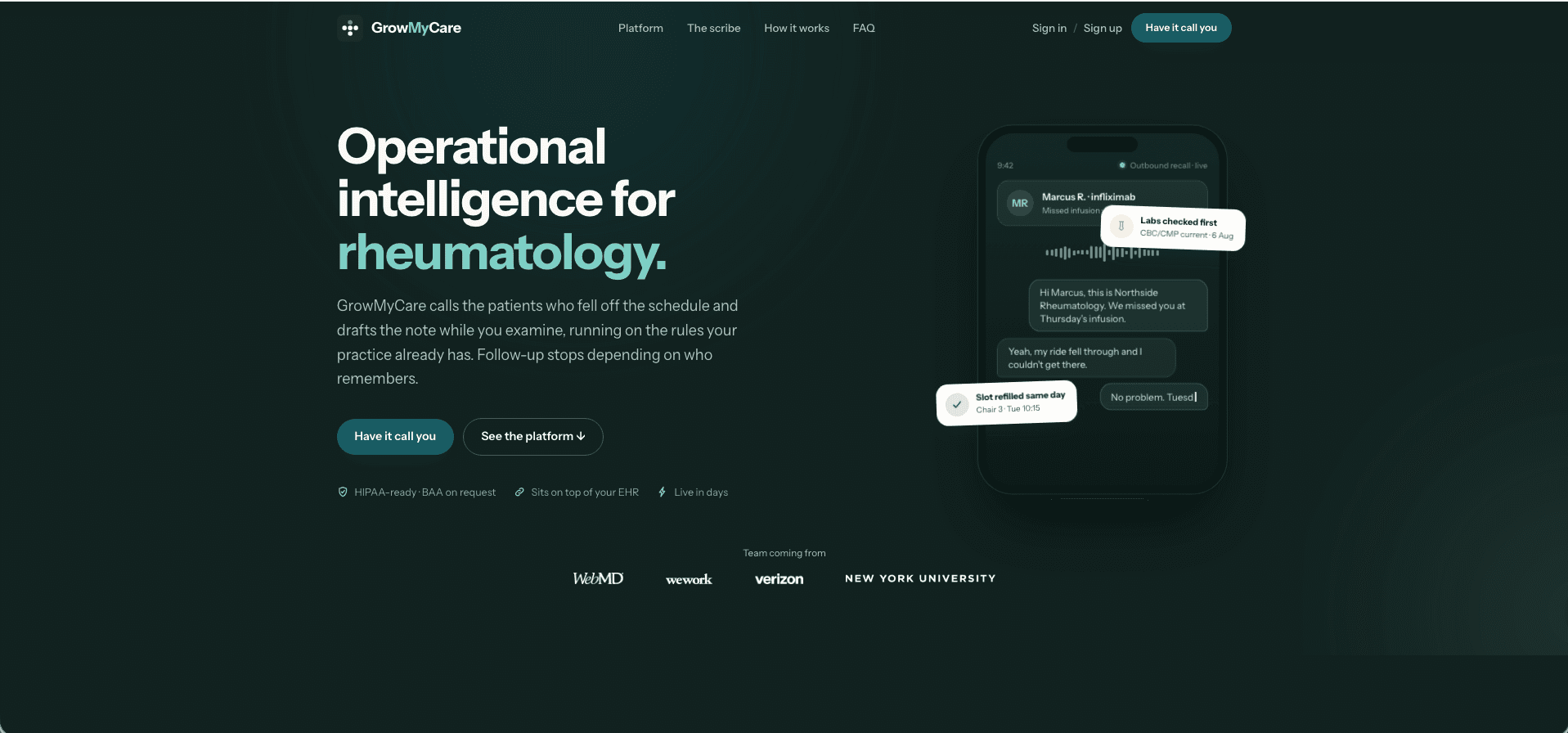
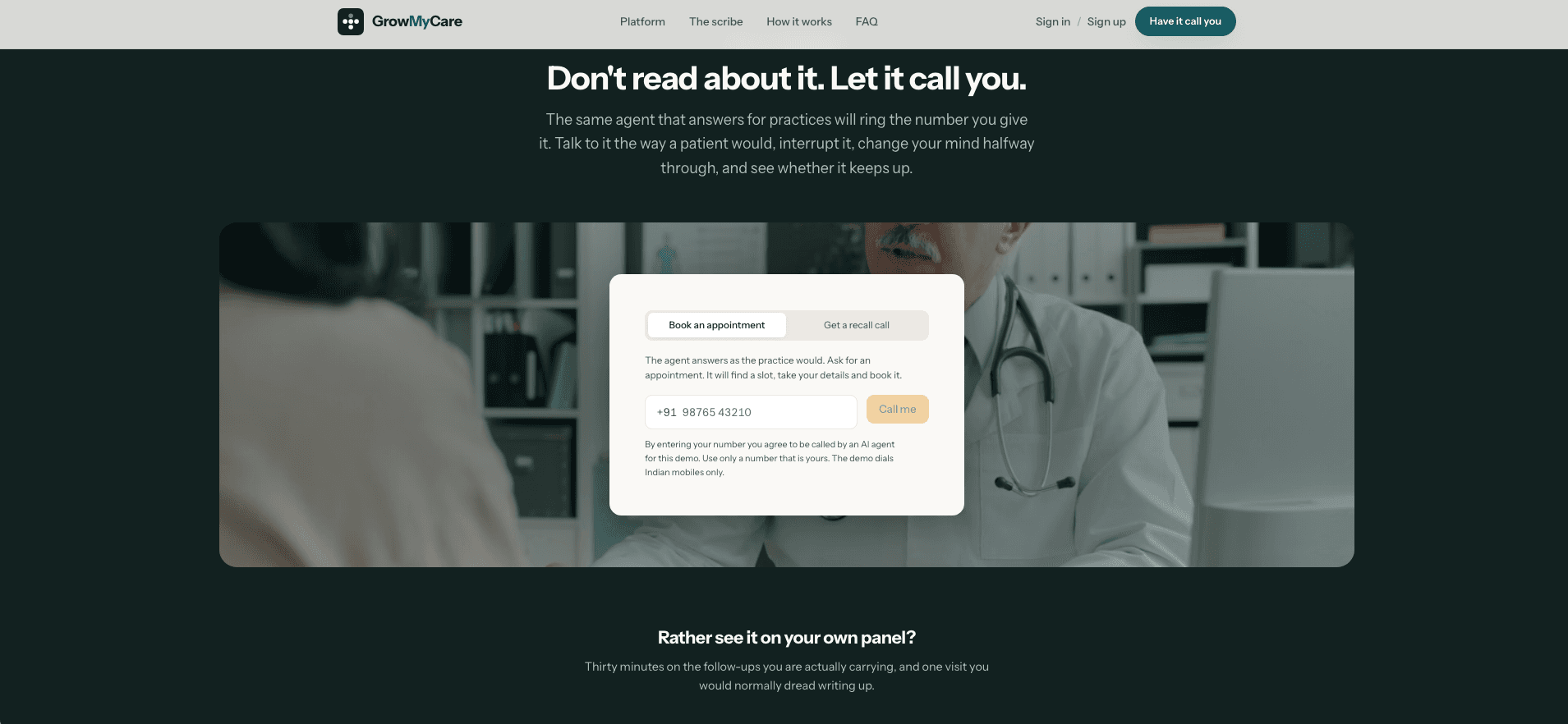
GrowMyCare's doctors get their attention back. The scribing, the scheduling, the recall calls: all of it runs quietly in the background now, and the only thing that ever lands on a doctor's desk is a finished report waiting for a signature.
We were impressed by the systems and mechanical workflow they've setup. The delivery came through in a structured and timed manner, that was a beautiful experience.