Context and problem
Accale is a platform for building AI agents that do a recurring job, not answer a single question. The first one most people build is a social media manager: it researches what the brand sounds like, writes the posts, designs the graphics, schedules them and reports back on what worked.
The difficulty with agents like this is rarely getting one to produce something. It is getting the output to sound like you, getting it to improve without drifting, and letting a person stay in charge without having to read every line the agent writes. Most agent builders hand over a canvas of nodes and wires and call that control. For somebody who is a product designer, not an engineer, wiring a pipeline is the work they were trying to avoid.
We built Accale so the starting point is a sentence. You say what you want done, and the platform assembles the team.
Approach
A recurring job splits into three different kinds of work, and agents that mix them up are the ones that go wrong. So an Accale is a team with three roles, and the interface is organised around them.
- Learners hold context. A brand manager keeps the guidelines, references and examples; a market researcher keeps what is happening around the brand. They understand, maintain and update that context, and define tasks for the other agents.
- Workers do the job. A content writer, a graphic designer and a scheduler each take a task from the learners and carry it out.
- Analysers watch the results. They monitor how each post performs and send what they find back to the learners, which closes the loop.
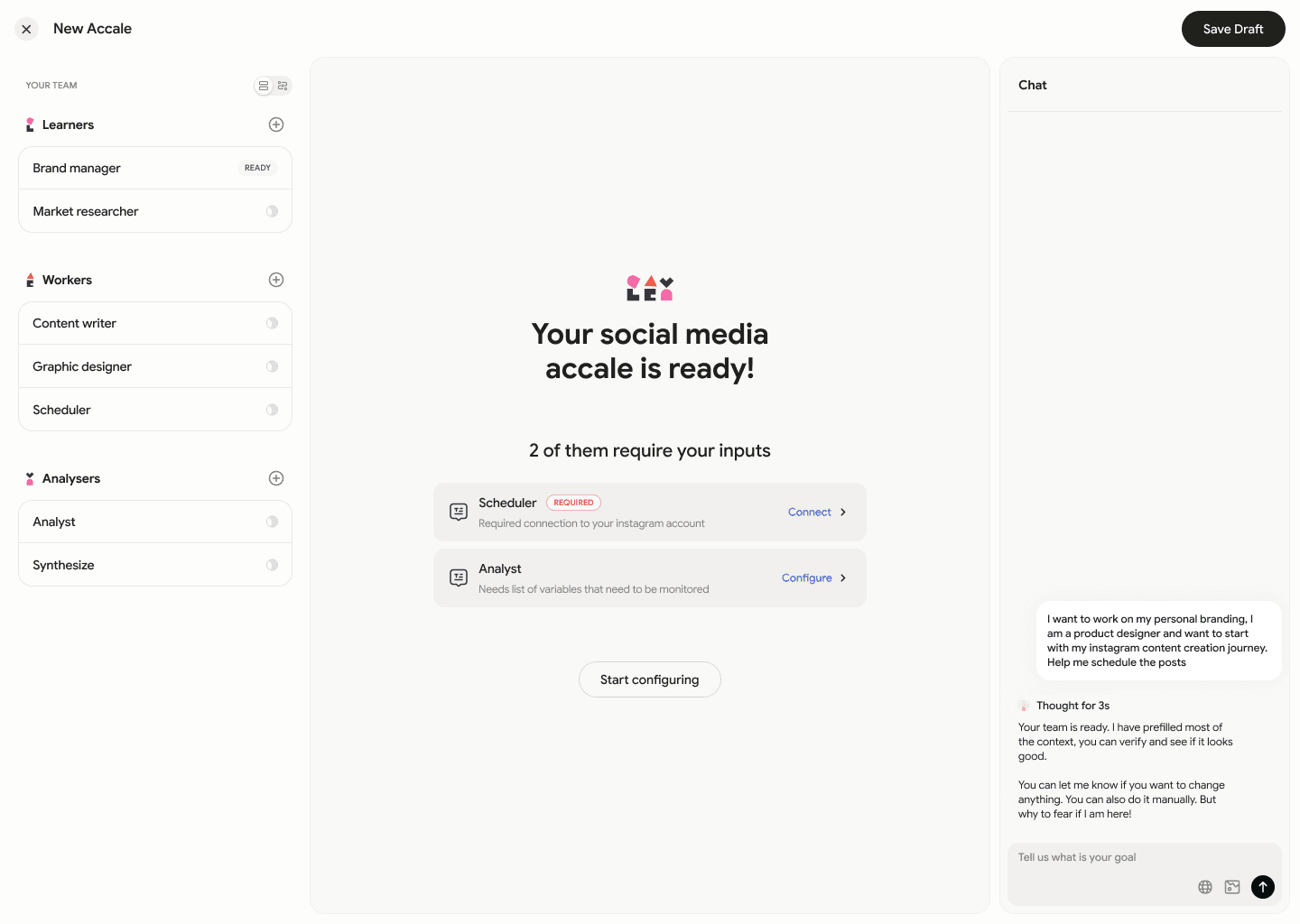
Building one starts in a chat panel. Tell it that you are a product designer starting on Instagram and want help scheduling posts, and it drafts the whole team, prefills most of the context and lists what only you can supply: connect the Instagram account, say which variables the analyst should monitor. Everything it set up can still be edited by hand, which matters, because people trust what they can see and change.
| Design decision | What it answers | What it looks like in practice |
|---|---|---|
| Agents grouped by role, not wired as a graph | A canvas of nodes nobody non-technical wants to maintain | Three lists on the left: learners, workers, analysers |
| Taste taught by example | Brand guidelines nobody can write down fully | Swipe good or bad on real samples, then keep the pile |
| Autonomy chosen per rule | Either no automation or no oversight | Auto-apply, suggest first, or log only, per rule |
Scroll sideways to see every column.
What we built
Teaching an agent taste without making the user write a style guide
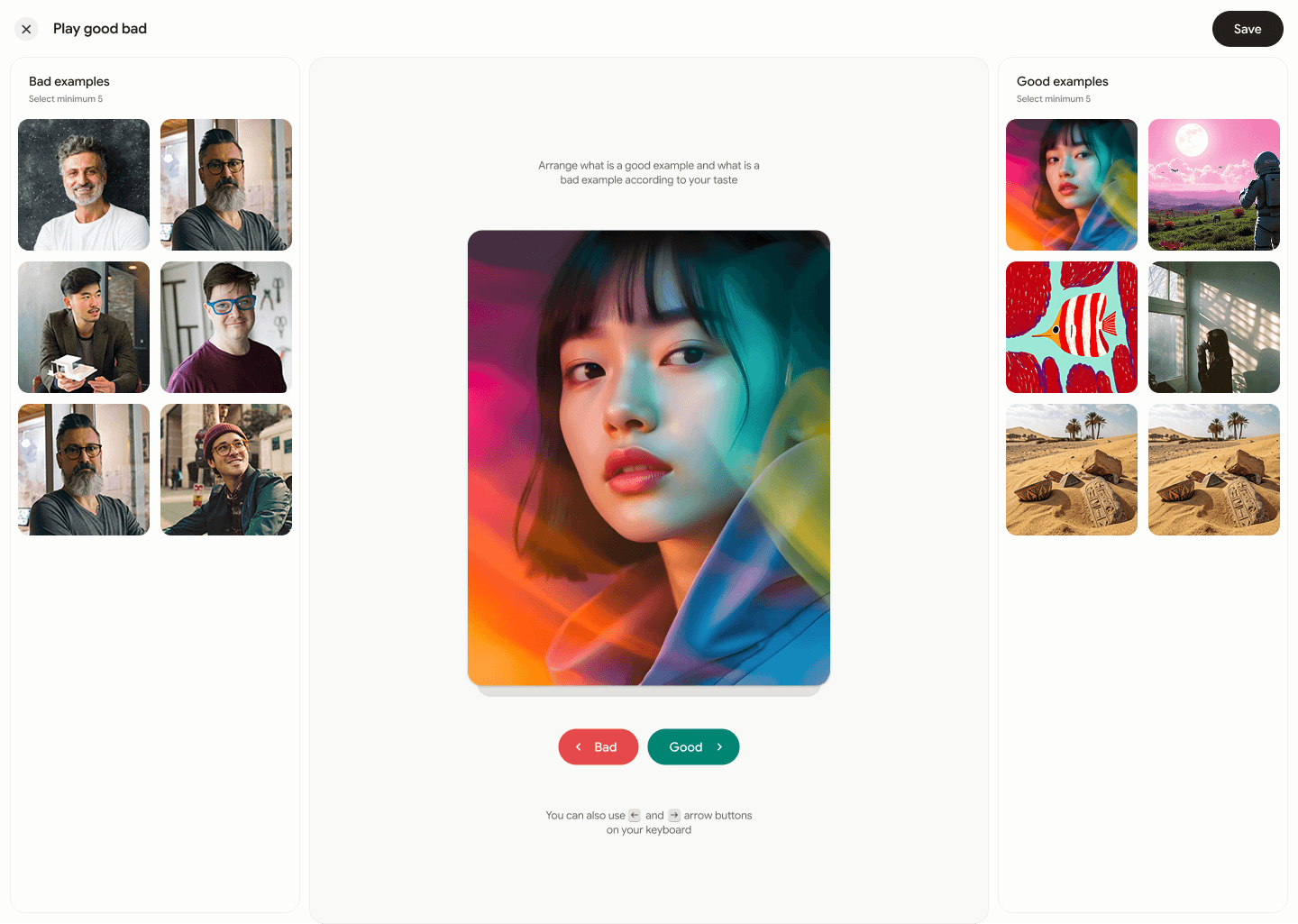
Ask somebody to describe their brand voice and you get a paragraph that fits a thousand brands. Ask them whether one particular picture feels like them and the answer is immediate. So the brand manager takes both: a plain-language goal with its acceptance criteria (a mix of 70% English and 30% Hinglish punch lines in every post, say), the resources you already have, such as brand books, images, videos and links, and a set of good and bad examples.
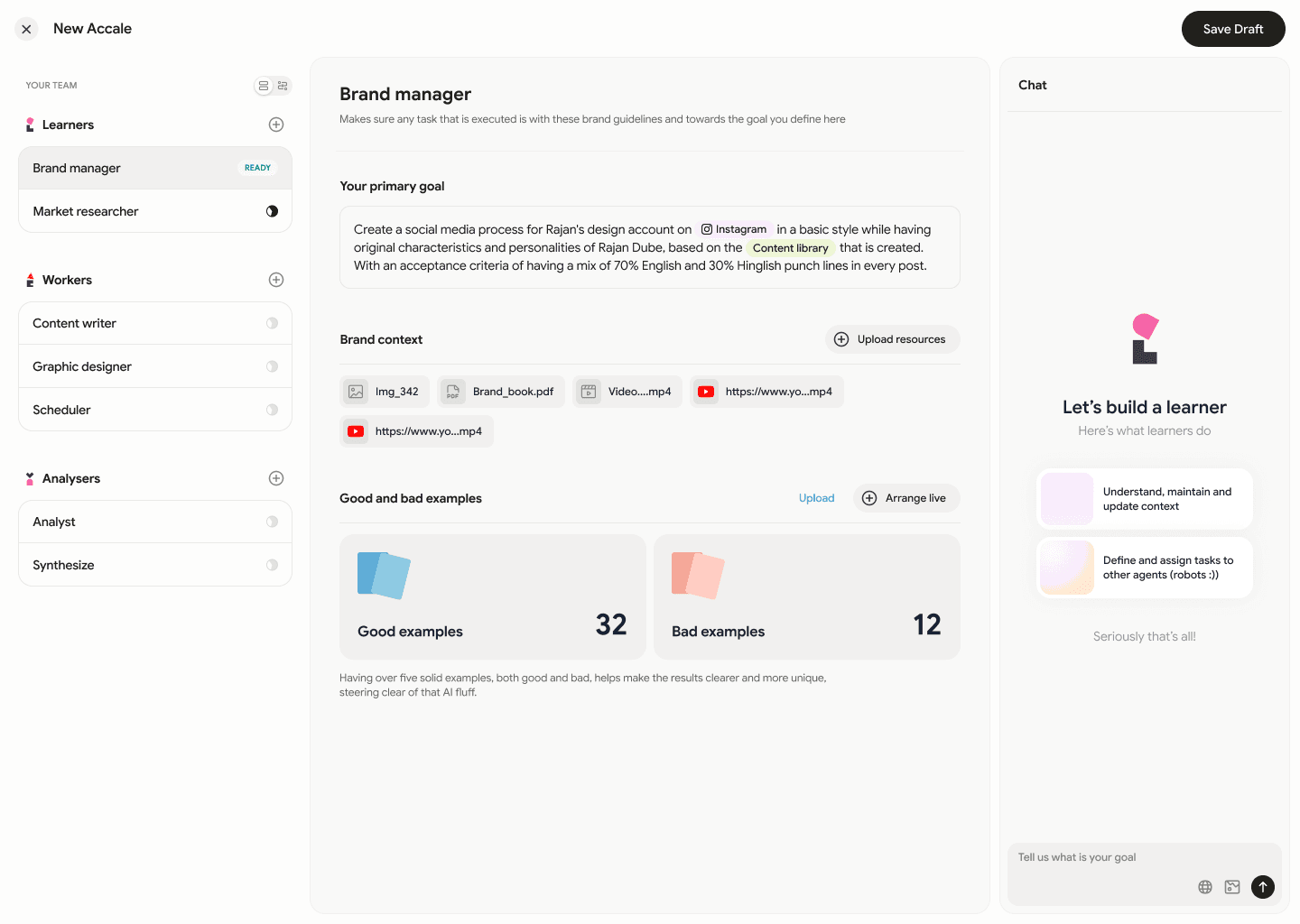
The examples are collected by a small game. One sample at a time, you send it left to Bad or right to Good, with the arrow keys if you like, and the two piles fill up on either side. It takes a minute, and it gives the agent contrast, the thing a written guideline almost never contains. We ask for a minimum of five on each side, because a handful of solid pairs makes results clearer and steers away from generic output.
Letting the team improve itself without letting it drift
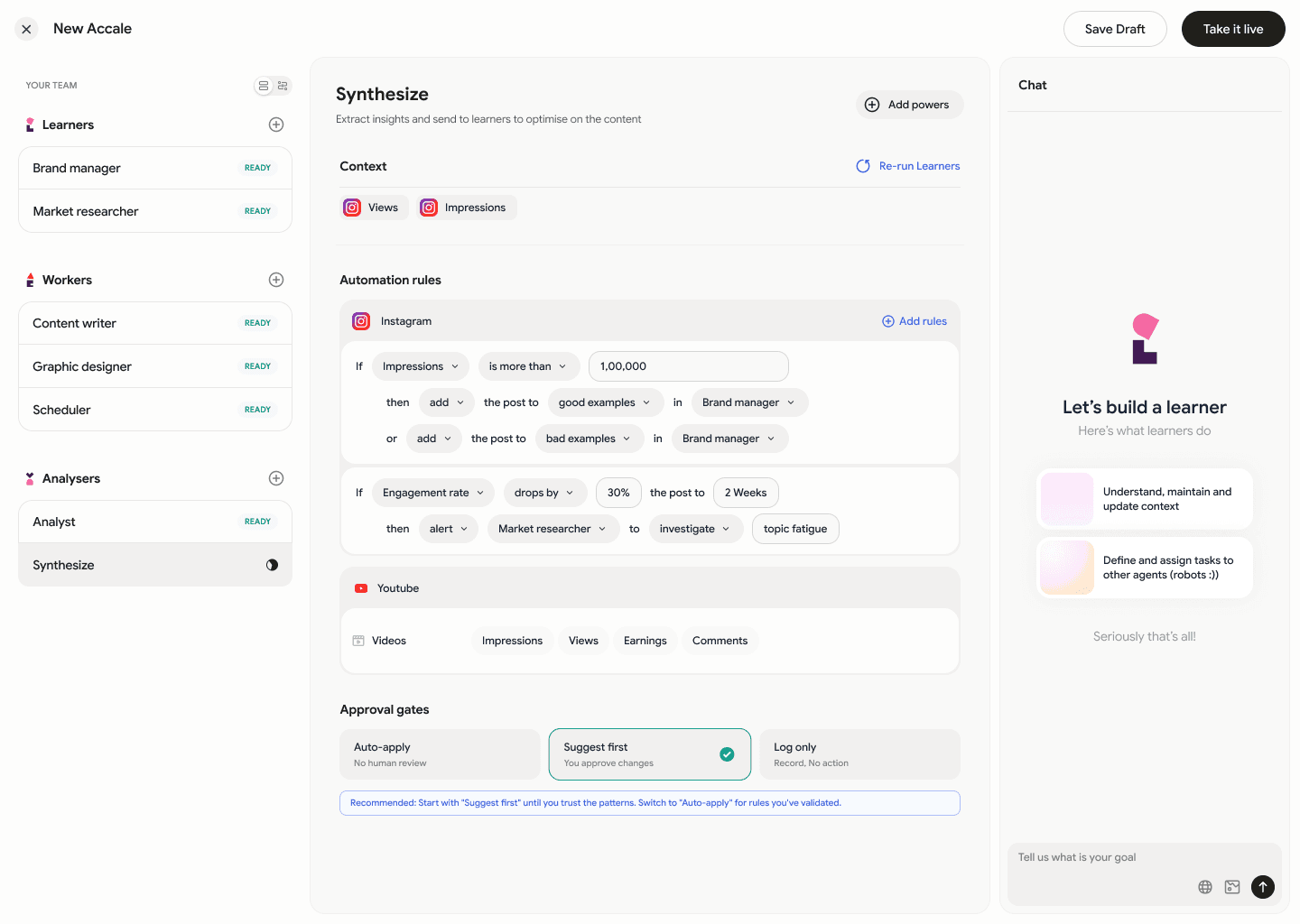
A system that learns from its own results can also learn the wrong thing, quietly. The synthesizer is where that is managed. It reads the analysers' numbers, such as views and impressions, and applies rules the user writes in a sentence-shaped form: if impressions pass a threshold, add the post to the brand manager's good examples, otherwise to the bad ones. If engagement drops by 30% over two weeks, alert the market researcher to investigate topic fatigue.
Rules alone are not the safeguard. Each one carries an approval gate, set to one of three levels: auto-apply with no human review, suggest first so the person approves changes, or log only, which records and takes no action. The platform recommends starting on suggest first until the patterns can be trusted, then promoting the rules that have earned it.
Making a team of agents readable at a glance
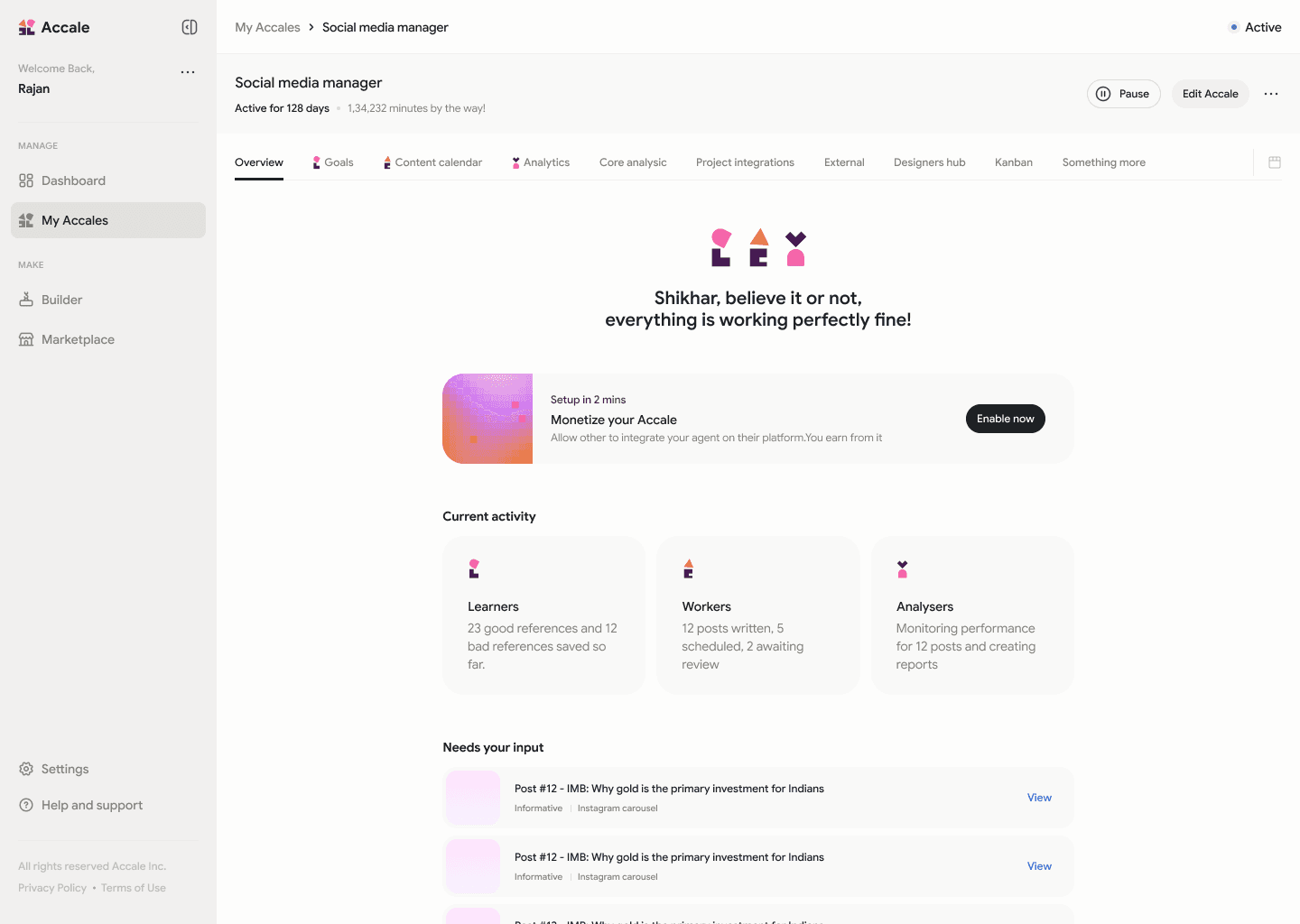
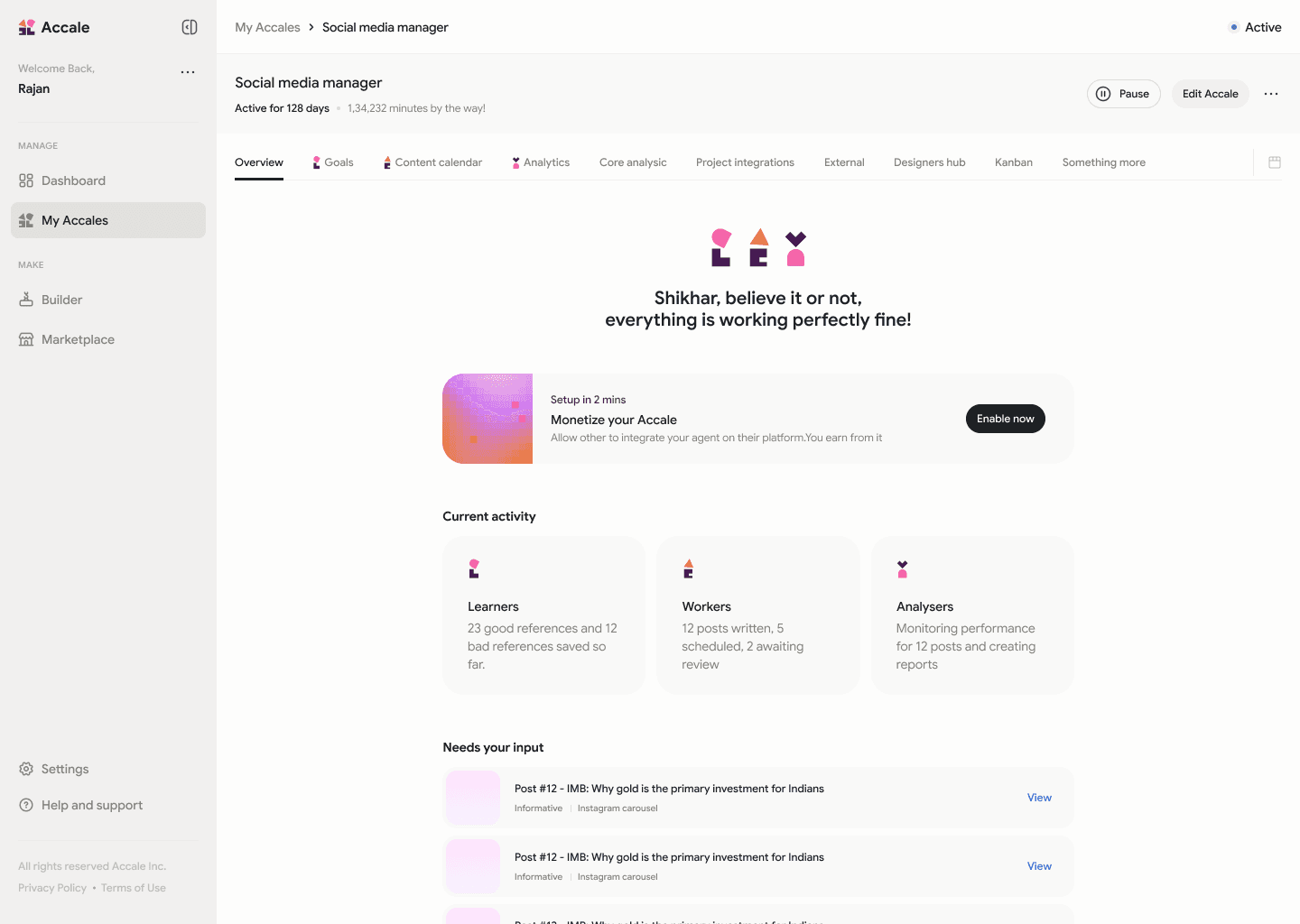
Once an Accale is live, the owner does not want a log. They want to know whether it is fine. The overview answers that in a line, then summarises each role in plain terms: how many good and bad references the learners have saved, how many posts the workers have written, scheduled or parked for review, and what the analysers are monitoring. Anything that needs a person sits underneath, headed Needs your input, with a link straight to the item.
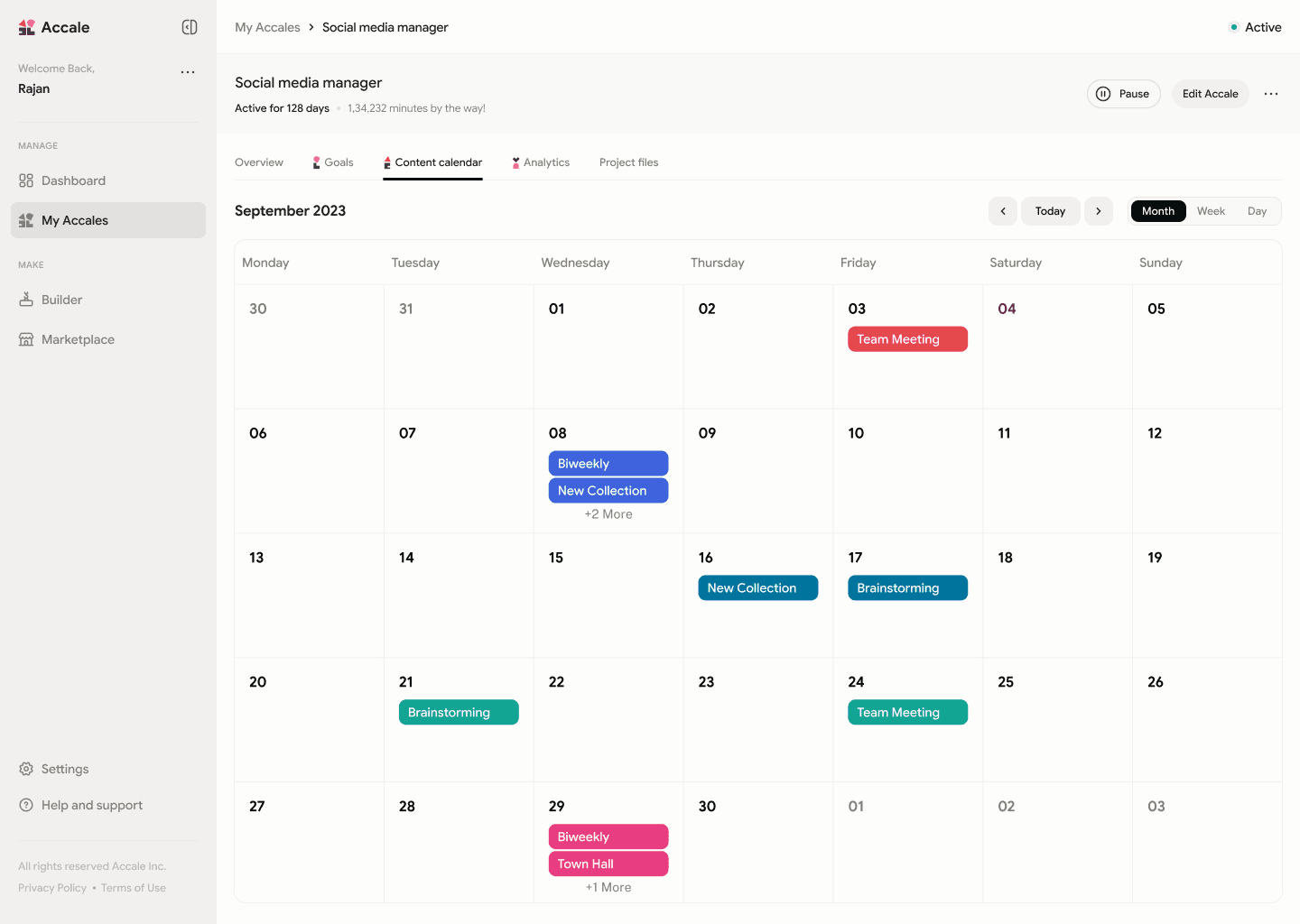
The same work is also laid out on a content calendar, month, week or day, so what the agents have planned is visible in the place a marketer already looks. Accales can also be monetised: the agent can be offered to other platforms to integrate, and its owner earns from the usage.
| Challenge | What we did | What it delivers today |
|---|---|---|
| Brand voice that cannot be written down | Context plus a good and bad sorting game | An agent steered by contrast, not adjectives |
| Self-improving agents that could drift | Rules with three approval levels | Autonomy that is granted rule by rule as trust is earned |
| Agent activity nobody can follow | An overview in plain language, with a needs-your-input list | The owner sees the state of the team in a few seconds |
Scroll sideways to see every column.
Outcome
Accale turns an agent from something an engineer wires up into something a specialist can describe, teach and supervise. A goal becomes a team of learners, workers and analysers, taste is captured by example, and automation is only as free as the person has chosen to make it.
It was a breeze working with the team given the scale of our complexities.